PHILANTHROPY AND PHILODENDRONS
The Basics: Floral Morphology
Most flowers are composed of four basic arrangements known as 'whorls.' Each of these whorls has a name, and consists of an arrangement of smaller parts that you may be more familiar with. Starting with the outermost whorl and working our way to the innermost whorl, we get:
Calyx - composed of the sepals
Corolla - composed of the petals
Androecium - composed of the stamens
Gynoecium - composed of the pistils
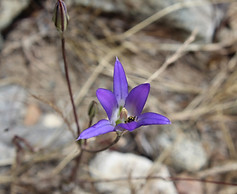
In the photo to the right, each of these whorls has been labeled. Something to note when looking at this photo is the coloration of the sepal. Although the sepal has similar coloration to the petals, sepals are most often green in color.
However, it is not unusual to see sepals that look similar to petals, and botanists often call sepals and petals that are indistinguishable from each other a new term: tepals.

Petal
Pistil
Stamen
Sepal
Image description: A photo of a Calochortus venustus inflorescence with one of the petals fallen off, showing both the inner and outer whorls of the flower.
Tepals

Stamen
Image description: A photo of a Silene laciniata
inflorescence with five erect stamens and no visible pistils.

Pistil
Image description: A photo of a Silene laciniata
inflorescence with withered stamens, exposing three incredibly small but erect pistils.
It is also important to consider that not all flowers are bisexual, or contain both male and female parts. The gynoecium is the whorl containing the female parts of the flower, and the androecium contains the male parts. However, some flowers are unisexual, containing only the gynoecium or only the androecium.
Another modification we often find when looking at flowers is the maturation of the androecium and gynoecium at different times. This adaptation helps prevent inbreeding, because it prevents a pollinator from removing the pollen from the androecium and immediately applying it to the gynoecium.
This adaptation is shown in the images above. The photo on the left depicts mature stamens, while the photo on the right has withered stamens and mature pistils.

Calyx
To the left I have included a photo of the calyx on a Silene laciniata flower, or the whorl of sepals surrounding the corolla. This way we can see all four whorls of the flower.
Another concept that is important to understand in floral morphology is that some flowers may have a very reduced or even missing whorl(s). This adaptation is usually due to a lack of difference in pollination success with or without the whorl. As a result, the species evolved to produce flowers without that whorl because creating those extra parts requires more energy. One example of a flower with a missing whorl is one of Clematis lasiantha, or the Pipestem Clematis. This plant has flowers completely lacking a corolla. In turn, the sepals are white and "fill in" for the petals by attracting pollinators to the flower.


Sepals
But what about floral symmetry?
Just as important as knowing the different parts of the flower is understanding how these parts can be arranged. Flowers can have all kinds of symmetry, but the most common kinds are radial and bilateral.
Actinomorphic/Radial

An actinomorphic flower is one that has many planes of symmetry- so many that if you draw a line through the center of the flower at any angle, the line will produce two halves that perfectly mirror each other.
Nymphaea sp.

Asarum lemmonii

Romulea komsbergensis

Hoya linearis

Dichorisandra penduliflora
Zygomorphic/Bilateral
A zygomorphic flower is one that has only a singular plane of symmetry, typically straight down the middle of the flower, producing two halves that mirror each other.

Paphiopedalum hirsutissimum

Diplacus kelloggii

Ibicella lutea

Aristolochia arborea

Seemannia sp.
However, these are not the only kinds of symmetry. You may also encounter biradial and asymmetric flowers, such as the ones shown below.
Biradial

Begonia sp.

Asymmetric
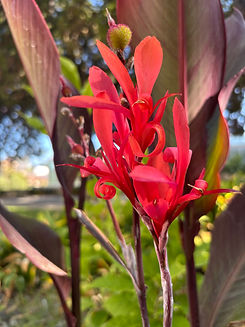
Biradial flowers have two planes of symmetry. This is why the name is a combination between radial and bilateral- they fit in between those categories. Asymmetric flowers, however, are an entirely new concept. This type of flower is perhaps the least common, and constitutes no plane of symmetry at all.

Canna sp.