PHILANTHROPY AND PHILODENDRONS
Musaceae
Despite working around Musaceae for the past four years and apparently taking a number of photos of them throughout this time, it was only recently that I fully understood their floral and vegetative morphologies.
It is not uncommon to refer to a banana plant as a tree, but they are technically classified as herbs (or herbaceous plants) because they lack any form of secondary growth.
Another misconception revolves around the stem of a banana plant. The stem is actually an underground storage organ classified as a corm, which is found in a number of monocot families including Araceae and Liliaceae.
As a result, the inflorescence of a Musaceae plant does not grow from what we consider the stem of the banana plant because that stem is actually a pseudostem composed of leaf sheaths which create a hollow cylinder.
Orange bracts subtending the flowers.

The yellow arrow represents the path the inflorescence had to take to make its way out of the pseudostem.
Photo Description: A photo of a Musa sp. in flower at the Royal Botanic Gardens, Kew. I estimate this individual was about 20-30 feet tall.
STAMINATE
FLOWERS
Musa flowers are unisexual, but the flowers often contain sterile remnant parts of the other sex. This is why each of the four flowers in the photo to the right have a sterile pistil, even though these are staminate flowers. Whenever a flower bears a sterile pistil, this is called a pistillode. As the photo shows, each flower bears five fertile stamens.
Other staminate flowers of Musa have been known to also contain a sixth stamen, which is sterile. Whenever a flower bears a sterile stamen, this is called a staminode. This is important to note because the staminode and the pistillode could be easily confused if you do not know that the staminate flower is capable of producing both.
This next photo provides a close up on the staminate flowers while they are still attached to the inflorescence. This allows us to see the pairs of thecae on each stamen.
The pistillate flowers produce a singular three lobed pistil, which is indicative of the three fused carpels that constitute the inferior ovary.
Similar to the staminate flowers, the pistillate flowers also have staminodes. Instead of having just one, the pistillate flowers have four to five staminodes, suggesting that at one point in time Musa flowers were bisexual.
As for the calyx and corolla, each flower maintains an inner and outer whorl of three tepals each. Five of the tepals (three outer and two inner) are fused together, with only one of the inner tepals left free.
This perianth formation creates zygomorphic or bilateral symmetry.
PISTILLATE
FLOWERS
Photo Description: A photo of a Musella lasiocarpa (syn. Musa lasiocarpa) inflorescence.
Instead, the inflorescence starts to grow directly from the underground corm, building upwards through the hollow pseudostem. Therefore, when we look at the inflorescence, we are looking at less than half to less than an eighth of the entire thing depending on how tall the plant itself is.
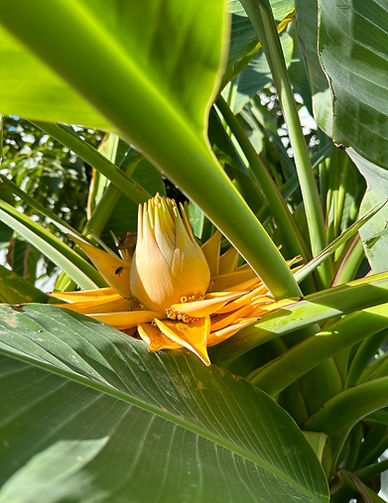
With that being said, the flowers themselves are relatively small. The showy part of the inflorescence are actually large bracts, or modified leaves. These bracts can be orange, red, burgundy, and pink as labeled in the photos on this page.
Each of these bracts subtends a whorl or multiple whorls of flowers which vary in number from species to species. These flowers are unisexual, with the female flowers produced at the start of the inflorescence and the male flowers produced towards the end.
In some species of Musaceae, the inflorescences are pendulous, such as the one shown to the left. In others, the inflorescences remain erect, such as the one in the image above.
One of five fertile stamens

Pistillode
*there are no staminodes in this photo
Photo Description: A fallen burgundy bract with four staminate flowers laid upon it, resting on top a layer of Ficus montana at the Royal Botanic Gardens, Kew.

One of five fertile stamens
Both thecae on one stamen


Subtending bracts
These last two images show what is most likely an edible Musa hybrid (left) along with Musa coccinea (right). The photo on the left was taken outside the Virginia Haldan Tropical House at the University of California Botanic Garden in Berkeley. From what I can recall, the photo of Musa coccinea was taken inside the Princess of Wales Conservatory at Kew Gardens. Both of these plants are good examples of color variation in the bracts subtending a whorl of flowers.